


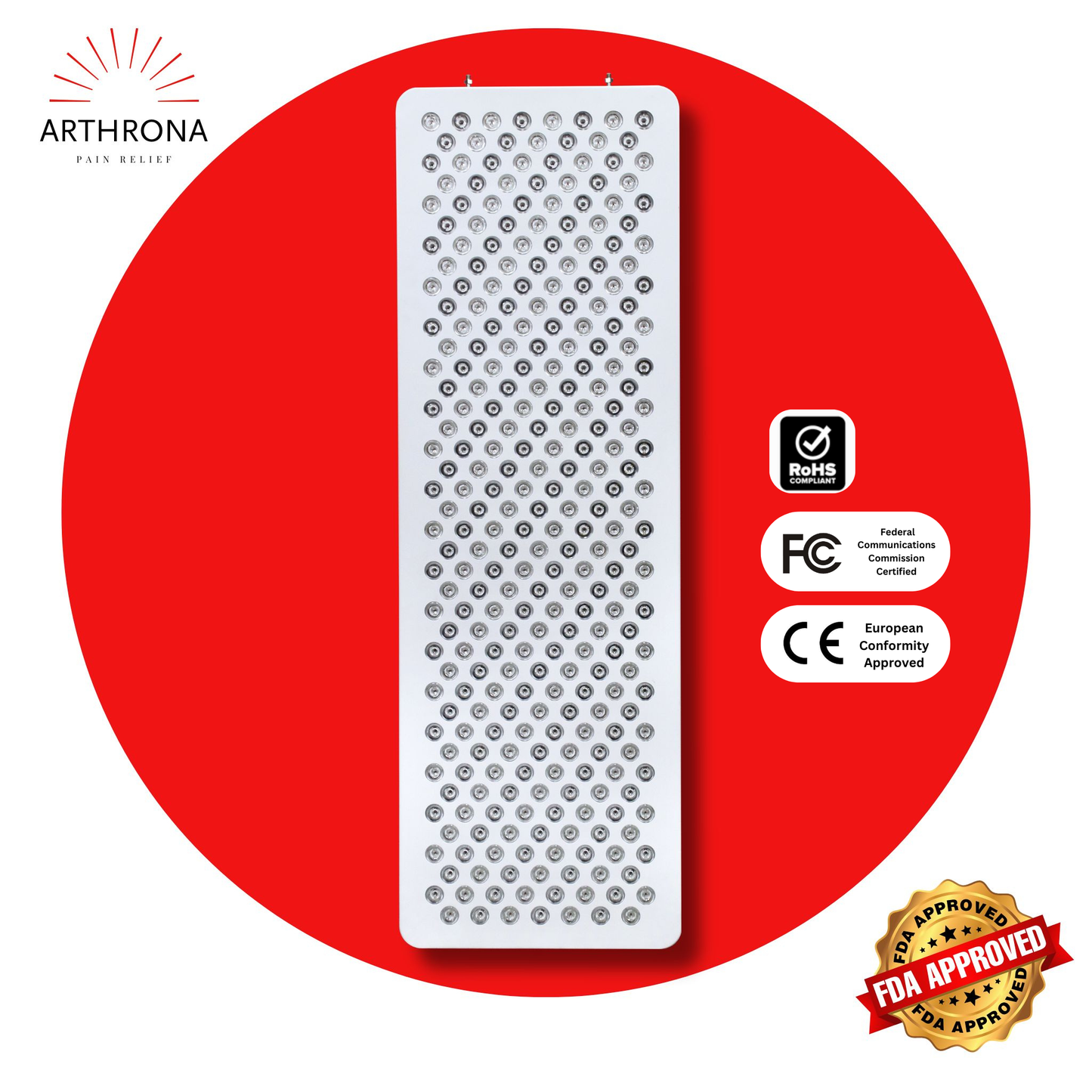
RDPRO 500
RDPRO 500
An error has occured. Please try again.
Doctors recommended red light therapy device with clinically proven results for faster healing and pain relief
Reduces Inflammation in Joints and Muscles
Increased blood flow to promote healing
All natural. No pain, side effects, or downtime

RDPRO 500
Clinically Proven Results
Clinically Proven Results
- Reduces inflammation
- Increases blood flow
- Increases energy of cells
- All natural. No pain or side effects
How to use
How to use
For best Results
Step 1) Ensure skin is clean and uncovered.
Step 2) Place within 3-6 inches from treatment area.
Step 3) Use for 5-15 minutes per area.
Step 4) Begin with daily sessions, then adjust.
Disclaimers
Disclaimers
- Arthrona red light therapy panels are designed to support general wellness, recovery, and joint comfort through the use of specific light wavelengths commonly studied in photobiomodulation research. Results may vary from person to person.
- These products are intended for non-invasive, at-home wellness use and are not intended to replace professional medical advice, diagnosis, or treatment. If you have a medical condition, are pregnant, or are taking medication, consult a qualified healthcare professional before use. Use as directed.
Order within the next 2 hours to get it before -
Couldn't load pickup availability
SHARE THE EXPERIENCE WITH SOMEONE YOU LOVE & GET 10% EXTRA OFF
RDPRO 500
RDPRO 500


Unlock Your Best Self with Red Light Therapy
Healing in Action: A Red Light Therapy Testimonial | Arthrona

Save Thousands with At-Home Therapy!
By saving $6,760 per year by not going to spa twice a week, you could invest those savings for long-term growth and upgrade your wellness lifestyle with features like an at-home gym, cold plunge tub, or sauna. Below shows the growth of those savings at 5% annually!
| Spa Visit Frequency | Weekly Savings (CAD) | Break-Even Point | Annual Savings (CAD) |
|---|---|---|---|
| Once a week | 65 | ~6 months | 3,380 |
| Twice a week | 130 | ~3 months | 6,760 |
| Three times a week | 195 | ~2 months | 10,140 |

Get Back that youthful GLOW!
Red and infrared light stimulate your skin and cells just like sunlight—but without the harmful UV rays or aging effects.
Clinically Backed. Cell Deep. Why Red & Infrared Light Works.


Chloe – Cleared Acne & Regained Confidence
This is Chloe. She struggled with acne for years, trying countless treatments with little success. She committed to 10–15 minutes of red light therapy per session, 4–5 times per week. Within 2 weeks, she saw a reduction in redness and inflammation. By 4–6 weeks, her breakouts were healing faster, and after 8–12 weeks, her acne was visibly clearer, with fewer breakouts and improved skin texture. Studies show that red light therapy reduces inflammation and promotes faster skin healing—helping Chloe finally achieve the clear skin she always wanted.

James – Overcame Knee Pain & Got Active Again!
Meet James. For years, knee pain held him back from running and staying active. He started using our red light therapy panel for 10–20 minutes per session, 3–5 times per week. Within 2 weeks, he noticed less stiffness, and by 4 weeks, his pain had significantly decreased. After 8 weeks of consistent use, he was back to jogging without discomfort. Clinical research confirms that red light therapy helps reduce inflammation, improve circulation, and relieve joint pain—allowing James to reclaim his mobility and stay active.

Margaret – Reduced Wrinkles & Rejuvenated Skin!
Meet Margaret. She wanted to reduce fine lines and restore her skin’s youthful glow. She used red light therapy for 10–20 minutes per session, 3–4 times per week. After 4 weeks, she noticed improved skin hydration and a slight reduction in wrinkles. By 8–12 weeks, her skin felt firmer, more elastic, and visibly smoother. Studies show that red light therapy stimulates collagen production, increasing skin firmness and reducing wrinkles over time—helping Margaret look and feel younger naturally.
Arthrona Specializes in the BEST Quality
Choose a brand you know you can trust. Our panels are the most high tech and innovative on the market!

🔥 High-Powered Irradiance for Faster Results!
Over 200mW/cm² at 15cm – Delivers maximum light absorption for deeper penetration and faster results. Get shorter sessions with better outcomes compared to weaker panels.
🔴 Full-Spectrum Red & Near-Infrared Light
630nm, 660nm (Red) + 810nm, 830nm, 850nm (Near-Infrared) – Red light boosts skin health and collagen, while near-infrared penetrates deep into muscles and joints for pain relief and recovery.
📏 Large Treatment Coverage for Full-Body Therapy
Covers 119cm x 60cm – Treat larger areas in one session, making it perfect for athletes, pain relief, and anti-aging therapy. More coverage = fewer sessions needed.
Let customers speak for us
I was worried about the price, but it’s been worth it for the pain relief alone.
It’s only been a month, but I can already tell my hair feels stronger.

I use this after my night shift, and it helps me reset my sleep schedule.
A must-have for athletes looking to optimize their recovery.

My wife and I both use it, and we’ve noticed a big improvement in our skin.

I use it on my lower back, and the relief is amazing.
My hands don’t feel as stiff in the mornings anymore.
I bought this for my parents, and they love how it helps with joint pain.
I sit in front of it while I read, and my skin looks much healthier now.
Really helps with my chronic migraines. Surprised at how well it works!
Super easy to set up, and I love that I can use it at home.
I travel a lot, and this has helped keep my energy levels stable.

I use it every morning, and I feel more energized throughout the day.
Great for relaxation and reducing stress.
This panel is powerful and well-built. Feels high quality!
Frequently Asked Questions
How far should I stand from a red light therapy panel?
How far should I stand from a red light therapy panel?
Most manufacturers recommend positioning yourself about 6 to 12 inches (15–30 cm) away from the panel for optimal results. At this distance, you receive good light intensity without being uncomfortably close. Always check your specific panel’s guidelines, though – very high-powered panels might suggest a slightly greater distance (e.g. 18+ inches) to prevent overexposure or excess heat.
How long should a session with a red light therapy panel last?
How long should a session with a red light therapy panel last?
A typical session with a panel lasts around 10 to 20 minutes per targeted area. Extending beyond 20 minutes on one area usually isn’t beneficial – studies indicate that after this point, cells have absorbed as much light as they can, so extra exposure yields diminishing returns. It’s more effective to stick to the recommended time and if needed, do another session later rather than one very long session.
How often should I use my red light therapy panel?
How often should I use my red light therapy panel?
You’ll get the best results by using your panel consistently multiple times per week. Many people start with about 3–5 sessions per week, and some even use it daily (especially if the device’s intensity is moderate). Red light therapy is generally safe to do every day as long as you don’t overdo each session, so the key is regular, repeated use – think of it like exercise for your cells, working best with a steady routine.
Do I need to wear eye protection when using a red light panel?
Do I need to wear eye protection when using a red light panel?
t’s a good idea to protect your eyes because panels can be very bright. Manufacturers often recommend wearing protective goggles or eyewear, or at least keeping your eyes closed during treatment. While red and near-infrared light aren’t UV and won’t damage the eyes like sunlight, the intense LED brightness could cause eye strain or irritation over time, so using eye protection is a prudent safety measure.
Should I expose bare skin when using a red light panel (or can I wear clothes)?
Should I expose bare skin when using a red light panel (or can I wear clothes)?
For maximum effect, use the panel on bare skin – don’t cover the area with clothing. Clothing (especially dark or thick fabric) can block a significant amount of the red and infrared light. In fact, tests show a thin dark shirt might allow only a few percent of the light through to your skin. Using the panel on clean, bare skin ensures the therapeutic light isn’t absorbed or scattered by fabric and can penetrate into your body as intended.
Is a larger panel more effective than a smaller red light therapy device?
Is a larger panel more effective than a smaller red light therapy device?
Larger panels are more time-efficient for treating big areas because they cover more of your body at once. For example, a full-size panel might bathe your entire torso or half your body in light in one session, whereas a small panel or handheld device only treats a small spot and you’d have to move it around to cover different areas. The effectiveness per area is similar if the power output is comparable, but a bigger panel means you won’t need multiple back-to-back sessions to address extensive areas.
What is the difference between red and near-infrared light on a panel?
What is the difference between red and near-infrared light on a panel?
Red light (around 630–660 nm wavelength) primarily affects surface tissues like the skin it’s great for improving skin health, collagen production, and superficial healing. Near-infrared (NIR) light (around 810–850 nm) penetrates deeper into the body, reaching into muscles, joints, and even bones. That’s why many panels include NIR LEDs: red light targets skin-level issues, while NIR can help with deeper tissue repair, reducing joint pain, and muscle recovery.
Why do some of the LEDs on my red light panel look like they’re not working?
Why do some of the LEDs on my red light panel look like they’re not working?
If some bulbs appear off, they’re likely the near-infrared LEDs, which emit light that’s invisible to the human eye. Red LEDs glow visibly red, but NIR light is beyond our visual range, so those LEDs won’t light up to our eyes even though they are actually on. (A simple test: view the panel through a phone camera – often you’ll see the “invisible” lights glowing on the camera display. In short, LEDs that look off are usually not broken; they’re just emitting infrared light that we can’t see.
Do red light therapy panels emit any harmful radiation (UV or EMF)?
Do red light therapy panels emit any harmful radiation (UV or EMF)?
No – a quality red light panel shouldn’t expose you to harmful radiation. These panels do not produce ultraviolet light, so there’s no risk of UV damage, tanning, or sunburn. As for electromagnetic fields (EMFs), the device will emit a small EMF similar to any electric appliance, but reputable panels are designed to keep EMF levels very low (often negligible at the recommended use distance). In other words, there’s no evidence of any dangerous radiation exposure from using a red light panel as directed.
Is there a best time of day to use my red light panel (morning or night)?
Is there a best time of day to use my red light panel (morning or night)?
You can use your panel whenever it fits your schedule, but timing can slightly influence the experience. Many people use red light in the morning to energize themselves or around workouts – for instance, right before exercise to help warm up muscles, or after exercise to aid recovery. It’s also fine to do sessions in the evening; however, because bright light can be stimulating, some experts suggest avoiding intense visible red light in the last 2–3 hours before bedtime. If you want to do late-night therapy, you could use only the near-infrared setting (since NIR light is invisible and less likely to disrupt sleep patterns) so you get the benefits without potentially interfering with your sleep hormones

If you are interested in beauty trends and self-care, you’ve probably encountered red light therapy (RLT). Formally known as photobiomodulation, doctors first discovered that red and near-infrared light wavelengths sped hair regrowth in the late sixties. Later studies found it boosted wound healing. Since then, it has gradually entered the esthetics field, initially gaining traction as an in-office tool for post-operative recovery in plastic surgery patients, explains Dr Prem Tripathi, a facial plastic surgeon based in Alamo, California.
Does red light therapy work? These are the benefits and drawbacks
READ MORE HERE!

Red light therapy (RLT) is an emerging treatment that’s showing promise in treating wrinkles, redness, acne, scars, joint pain and other signs of aging. Many researchers say more clinical trials are needed to confirm its effectiveness as a treatment. If you’re interested in red light therapy, ask your healthcare provider if this is an option for your skin issue.
Red Light Therapy
READ MORE HERE

Red light therapy is a popular treatment option that can rejuvenate and heal your skin, aid in muscle recovery, and manage pain. Red light therapy is also safe to use, as it does not contain UV waves, and the availability of portable therapy devices means that you can reap its benefits in the comfort of your own home. If you’re interested in trying red light therapy at home but aren’t sure where to start, we will walk you through how to use red light therapy, including what kind of device you should use, how often you should use it, and how it can treat specific areas.